
9 General Data Protection Regulation (GDPR) Compliant Email Marketing Platforms 2025
Share this article:
Reading time: 11 min read
Do you remember the 1978 "spam" pulled by Gary Thuerk? He was the first to send 400 mass emails. They Were considered the first "spam" message. The General Data Protection Regulation (GDPR) reduces the risk of such spam. Read further!
Email marketing remains one of the most effective digital marketing strategies for businesses, but it also requires the collection and processing of users’ personal data. Without strong data protection measures, email campaigns can easily violate privacy regulations and undermine customer trust.
Before modern privacy laws such as the General Data Protection Regulation (GDPR) were introduced, many companies collected email addresses and personal information without explicit consent. Around 15 years ago, it was common for marketers to store, share, and use subscriber data without transparency, exposing users to privacy risks and unethical data practices.
For example, in 1978, Gary Thuerk sent the first known mass commercial email which many now consider the first "spam" message to nearly 400 users. The email advertised an open house to showcase the Digital Equipment Corporation (DEC) new DECSYSTEM-20 computers.
While the campaign was a huge commercial success, there were several complaints from users who felt the unsolicited message was an inappropriate use of the network, indicating how several companies collected and used users personal data without clear consent.
Users had little control over how their information was stored, shared, or used. Data could be mined for marketing, sold to advertisers, or used to track online behavior, often without the knowledge of the individual. Poor security practices meant data breaches were common, putting people at risk of identity theft and fraud.
If a company comes up front and asks for consent to freely share or sell your personal data among advertisers, data brokers, and third parties especially if you do not gain anything from such operation, you will literately be very hesitant. And you really need to be. Therefore, consent is often hidden in long legal terms or automatically assumed, meaning that simply using a website or app could result in extensive tracking and profiling.
About 15 years ago, that was the case. Companies and individuals would literally mine your data assuming you consented because you used their website or they would hide sensitive information about which data they are collecting, how they are collecting them and what they are doing with them in long legal terms. When Gary Thuerk sent that 400 emails, at the time, the ARPANET had around 2,600 users in total, and their contact information, including email addresses, was published in a physical "phone and email book".
Thuerk went through this printed directory and manually highlighted the names and addresses of users and organizations located on the U.S. West Coast, as he wanted to invite them to a local product demonstration. This means that all the recipients of his message did not give their consent to receive that message.
However, it was possible to do this because, at that time, mass mailings were not explicitly prohibited or restricted as they are now. During this frustrating period of unrestricted mining of users’ data, thousands of individuals were heavily affected.
The Introduction of the General Data Protection Regulation (GDPR)
To protect users, the European Union introduced the General Data Protection Regulation (GDPR) in 2018. It was first adapted in 2016. E-commerce platforms were given additional two years to adjust to the new policy. GDPR requires that businesses obtain explicit consent before collecting or using personal data, including email addresses.
It gives individuals rights such as accessing, correcting, deleting, and limiting the processing of their data. Organizations must also explain clearly how they use personal data, integrate privacy into their systems, and protect data from breaches.
For email marketers, GDPR compliance is crucial. Using a platform that meets GDPR standards ensures that businesses respect user privacy and avoid legal penalties while running campaigns safely.
The General Data Protection Regulation (GDPR) is not only highly applicable in Europe because it was enacted by the European Union, but it also has significant extra-territorial scope. Any organization, regardless of its physical location, must comply with the GDPR if it processes the personal data of individuals who are in the European Union (EU) or European Economic Area (EEA) under specific conditions.
For example, U.S.-based e-commerce companies that ships products to customers in Germany and allows payment in euros would fall under the scope of the GDPR. U.S. Based Companies that have dominant e-commerce presence in Europe
Amazon

Amazon collects customer emails for order confirmations, shipping updates, and promotional campaigns. To comply with GDPR in email marketing, Amazon ensures that EU customers provide explicit consent before receiving marketing emails, avoiding pre-checked boxes. Every marketing message includes a clearly visible unsubscribe option, allowing users to opt out easily.
Amazon also follows the principle of data minimization, using only the necessary information such as name and email for campaigns without unnecessary profiling. Transparency is emphasized through clear privacy policies explaining how customer data is used for marketing and how it may be shared with affiliates. In addition, email lists are stored securely with access controls to prevent unauthorized use.
eBay
For eBay Germany, GDPR compliance in email marketing involves active consent management: EU users must opt in to receive newsletters or promotional emails. The platform provides preference centers where users can manage the types of emails they receive and opt out of specific communications. eBay ensures that emails are sent based on user activity or explicit preferences rather than hidden profiling. In the event of a data breach affecting email information, eBay must notify users promptly, in accordance with GDPR’s 72-hour rule. Furthermore, eBay practices data minimization and retention, using only the information necessary for marketing purposes and regularly deleting outdated data.
Wayfair

Wayfair’s GDPR-compliant email marketing practices include opt-in subscription forms for EU visitors, ensuring that marketing emails are only sent to users who provide explicit consent. Email lists are segmented based on consent, preventing non-subscribers from receiving communications. Wayfair respects users’ right to erasure, allowing customers to request deletion of their email addresses from all marketing databases. Privacy notices are provided on all relevant pages and emails, clearly explaining how data is collected and used. Additionally, subscriber data is protected through secure handling practices, including encryption and restricted access.
Apple

Apple aligns its email marketing practices in the EU with GDPR requirements. EU users must provide explicit consent before receiving newsletters, product updates, or promotional emails. Apple offers granular preference management, allowing subscribers to choose the types of emails they wish to receive and to modify preferences at any time.
The company follows data minimization principles, collecting only relevant information for marketing purposes. Transparency is maintained through clear privacy policies, and all emails include unsubscribe links. Apple also ensures that users can exercise their GDPR rights, such as accessing, correcting, or deleting their personal data, while maintaining strong security measures to protect email information.
9 Email Marketing Platforms That are GDPR Compliant
Hostinger Reach

This email marketing platform provides AI-assisted email creation, automation, and analytics, and it explicitly incorporates GDPR compliance features. Users can manage consent, provide clear unsubscribe options, and store subscriber data securely, making it suitable for beginners and solopreneurs targeting EU subscribers. I have explained the features of this platform. Read here!
Omnisend

This platform is focused on e-commerce and supports email, SMS, and web push. It is GDPR-compliant, offering consent management, easy opt-in forms, and data protection measures to ensure that EU subscriber data is handled lawfully.
MailerLite
Features a drag-and-drop builder, automation, and analytics while providing tools for GDPR compliance, such as consent checkboxes, subscriber management, and easy unsubscribe functionality, making it beginner-friendly.
HubSpot

The tool integrates CRM, automation, segmentation, and analytics. Its platform includes GDPR-focused tools like cookie tracking consent, explicit opt-ins, and subscriber data management, helping businesses maintain compliance across complex workflows. I have explained the features of this platform. Read here!
Klaviyo

This email marketing tool leverages automation, segmentation, personalization, and analytics. It provides GDPR-compliant features such as consent capture, data minimization, and secure storage, which are essential for personalized email campaigns targeting EU users.
Mailchimp

MailChimp offers templates, automation, A/B testing, and analytics. It provides GDPR-compliant features including consent forms, preference centers, and data handling policies to ensure subscriber rights are respected.
Brevo
Brevo, (formerly Sendinblue) includes automation, CRM, and compliance tools, and it explicitly supports GDPR compliance with multilingual interfaces, consent tracking, and secure subscriber management, ideal for small global businesses.
SendGrid

SendGrid is a developer-focused platform offering automation, analytics, and deliverability tools. It is GDPR-compliant when used properly, including features like secure data storage, opt-in management, and compliance with EU data protection regulations.
Mailgun

Mailgun provides deliverability tools, analytics, and API integration for developers. Its services support GDPR compliance by enabling consent management, secure storage, and clear subscriber rights handling. I have explained the features of this platform. Read here!
Key Objectives of GDPR in Email Marketing
The General Data Protection Regulation (GDPR) was introduced to strengthen personal data protection and give individuals more control over how their information is used in email marketing. Its main objectives in this context are to ensure that marketers collect, process, and store email subscriber data responsibly.
GDPR empowers users with enhanced rights, such as the ability to access the information marketers have about them, correct inaccuracies, delete their email address from mailing lists, or restrict the way their data is used.
It also emphasizes transparency, requiring email marketers to clearly explain how and why subscriber data is collected, how it will be used, and whether it will be shared with third parties. Another key goal is data protection by design and by default, meaning that email platforms and campaigns must be built with privacy considerations in mind from the start.
Who Must Comply with GDPR in Email Marketing?
GDPR applies to any organization within the EU that sends marketing emails or processes email subscriber data. It also applies to companies outside the EU that offer goods, services, or email communications to EU residents, or track their online behavior.
This extraterritorial scope means that global businesses whether based in the U.S., Asia, or Africa must follow GDPR when handling EU subscriber data. Using GDPR-compliant email marketing platforms ensures that businesses meet these requirements while running campaigns safely and legally.
Individual Rights Under GDPR in Email Marketing
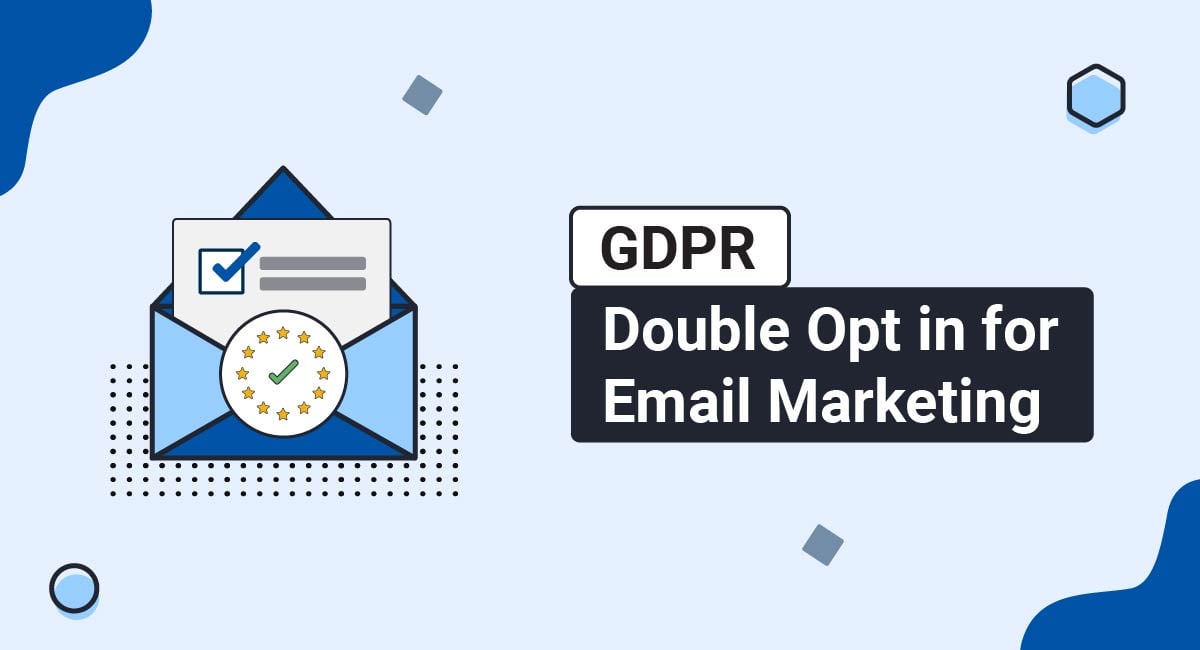
If you’re using email marketing to reach customers in Europe, GDPR compliance is something you can’t afford to ignore. Since email addresses are classified as personal data under the GDPR, businesses must handle them carefully. But does GDPR actually require double opt-in for email marketing?
The short answer is no. The longer and more practical answer is that using double opt-in is often the safer and smarter choice.
Double opt-in means that subscribers must confirm their email address before being added to your mailing list. While this process isn’t explicitly required by the GDPR, it offers several important benefits, including stronger consent records, better data quality, and reduced legal risk. check TermsFeed for details on GDPR double opt in for email marketing.
In this post, we’ll explain what the GDPR requires for email marketing, especially for businesses targeting European customers. We’ll also look at a European country where double opt-in is legally required and discuss why adopting double opt-in as a standard practice can help protect your business while improving your email marketing results.
GDPR gives email recipients several important rights that marketers must respect. The right to access allows subscribers to request a copy of their personal data stored by the email platform. The right to rectification ensures that inaccurate or outdated information, such as an incorrect email address or name, can be corrected. Brevo, for example, allows recipients to update their information using a built-in form.
The right to erasure (or “right to be forgotten”) allows users to unsubscribe and have their data deleted from marketing databases. The right to data portability enables subscribers to transfer their email data to another service if they wish. Finally, the right to object allows individuals to opt out of specific email campaigns, including promotional or direct marketing messages. Respecting these rights is essential for GDPR-compliant email marketing.
Why GDPR Matters in Email Marketing Today
GDPR has become a global standard for ethical and lawful email marketing. By enforcing transparency, accountability, and user control, it ensures that subscribers trust the brands they engage with and reduces the risk of legal penalties. Many countries, including Brazil (LGPD), South Africa (POPIA), and U.S. states like California (CCPA), have adopted similar rules inspired by GDPR.
For email marketers, GDPR compliance not only protects user data but also improves engagement, as recipients are more likely to interact with campaigns when they know their privacy is respected. Overall, GDPR sets the benchmark for responsible email marketing in the digital age.
Conclusion
In a digital world where trust is everything, GDPR-compliant email marketing not only protects user privacy but also helps brands build stronger, more meaningful relationships with their audiences. By respecting data rights and adopting ethical practices, businesses can market confidently while ensuring their subscribers feel safe, valued, and in control.
Until we meet again, cheers to your success in whatever you want to achieve!
Share this article:
Join the family
Related Articles

Mastering Content Marketing: Your Guide to Building an Audience

Building a Sustainable Business: More Than Just a Trend

The “rich man poor man analogy of website”— The art of developing authoritative websites

The things they don’t tell you about advertising— how to increase sales
