
Liberia Business Registration Requirements and Step-by-Step Process — 2026
Share this article:
Reading time: 10 min read
Step-by-Step Process for Business Registration in Liberia
Building a great reputation for your brand begins with having a legal identity. Starting a business in any part of the world means associating with a particular culture and as such, you must be legally identified by the members of that culture to survive. That where registering your business with the Liberia Business Registry comes into play.
As Liberia moves toward the full implementation of its development agendas, the formalization of businesses has become a cornerstone of national economic policy. To ensure full advantage of these benefits, rising entrepreneurs must follow a series of practical steps that transform a business idea into a recognized legal entity.
This article serves as your comprehensive handbook for understanding eligibility criteria, fiscal obligations, and the legislative framework that shapes business operations in Liberia. By the end of this article, you will not only know the technical steps to business registration but also understand how compliance strengthens your legacy as a business owner in a thriving and competitive marketplace.
Legal and Institutional Review
The Liberian business environment is regulated by a framework designed to balance entrepreneurial freedom with public accountability. Understanding these frameworks is the first step toward navigating the registry without friction.
1. Liberia Business Corporation Act (BCA): the BCA acts as the primary statute governing the formation, operation, and dissolution of corporations. It provides the legal "personality" of your business, allowing it to own property and enter contracts.
2. Liberia Business Registry Regulations: These regulations provide the specific administrative procedures for registering various business types, from sole proprietorships to complex partnerships. Take a took at the registry handbook.
3. Revenue Code of Liberia (2000, amended 2011): This code establishes the fiscal relationship between the state and the business, including the vital requirement for a Tax Identification Number (TIN). Review the revenue code as amended, 2011.
4. Investment Act of 2010: This act is particularly crucial for those looking to scale, as it outlines protections and incentives for investors, requiring businesses to be properly registered to qualify for tax holidays or duty-free privileges.
5. Decent Work Act (2015): in most cases, registering a business means preparing for operations. As such, you need to hire competent individuals. Therefore, you must understand the Decent Work Act. the Decent Work Act is the primary labor law ensuring that the growth of an enterprise does not come at the cost of human dignity or safety.
Responsible Government Agencies
The efficiency of your business registration in Liberia depends largely on how well your process is coordinated across four key government institutions, each of which plays a distinct role in establishing and operationalizing a business. These institutions work together to ensure that a company is legally registered, tax compliant, properly licensed, and, where applicable, eligible for investment support and incentives.
1. Liberia Business Registry (LBR): The official "one-stop shop." It handles the intake of applications and is the only body authorized to issue the Business Registration Certificate.
2. Ministry of Commerce & Industry (MOCI): The parent body of the LBR, overseeing trade standards and ensuring that businesses operate within the scope of Liberian commerce laws. Visit the** MOCI for more details.**
3. Liberia Revenue Authority (LRA): The gatekeeper of the nation's purse. The Liberia Revenue Authority issues TINs and is responsible for collecting the taxes that fund national infrastructure.
4. National Investment Commission (NIC): A promotion agency that assists larger enterprises and foreign investors in navigating the Liberian market and securing incentives.
Registration Requirements and Eligibility
Before visiting the Liberia Business Registry, an entrepreneur must ensure that all required documents are complete and accurate, including the Beneficial Ownership (BO) form. This form is now an important part of the registration process because it identifies the real individual or individuals who ultimately own or control the business, beyond the names listed on the incorporation documents.
Failure to submit the Beneficial Ownership form correctly, along with other required paperwork, can lead to delays, added costs, and repeated visits, making proper preparation essential for a smooth business registration process in Liberia. According to current LBR and NIC standards, applicants must prepare the following:
1. Completed Business Registration Form: Applicants should complete the applicable Liberia Business Registry registration form for their business type, commonly identified in practice as Form RF-001 for many entities.
2. Articles of Incorporation or Partnership Agreement: These are the "constitutional" documents of your business that define its structure and purpose. Valid Identification: Liberian citizens must provide a passport or National ID (NIR). Foreign nationals must provide a valid residence permit.
3. Proof of Address: This can be a utility bill, a lease agreement, or a formal location description signed by a local authority.
4. TIN Application Form: Usually integrated into the LBR process but processed by the LRA.
5. Payment Receipts: Official receipts from the Central Bank window located at the LBR.
Eligibility Criteria
1. Age and Capacity: Individuals must be at least 18 years old and legally capable of entering binding contracts.
2. Foreign Status: While the Investment Act of 2010 welcomes foreign capital, non-Liberians must comply with specific capital thresholds—generally $300,000 USD for a wholly-owned foreign entity, or $100,000 USD if partnering with a Liberian who owns at least 25% of the shares.
3. Sector Restrictions: Certain sectors, such as petty trade, travel agencies (small scale), and tire repair shops, are strictly reserved for Liberian citizens.
The Step-by-Step Registration Process
The process in Liberia has been streamlined significantly to encourage formalization, though it still requires physical presence or a registered agent for certain steps.
1. Name Search and Reservation: Before any forms are filled, you must ensure your business name is unique. A name can be reserved for 120 days for a fee of approximately $15 USD.
2. Submission of Application: Submit your forms and supporting documents to the LBR. If you are forming a Limited Liability Company (LLC), you will also need "Form Q" for the tax authority and "Form E" for incorporators.
3. Assessment and Payment: An LBR officer will assess your documents and provide a payment slip. You must take this to the designated Central Bank of Liberia window within the same building.
4. Verification and TIN Generation: Once payment is confirmed, your data is shared with the LRA. They will generate your Tax Identification Number, which is a unique lifetime identifier for your business's fiscal activities.
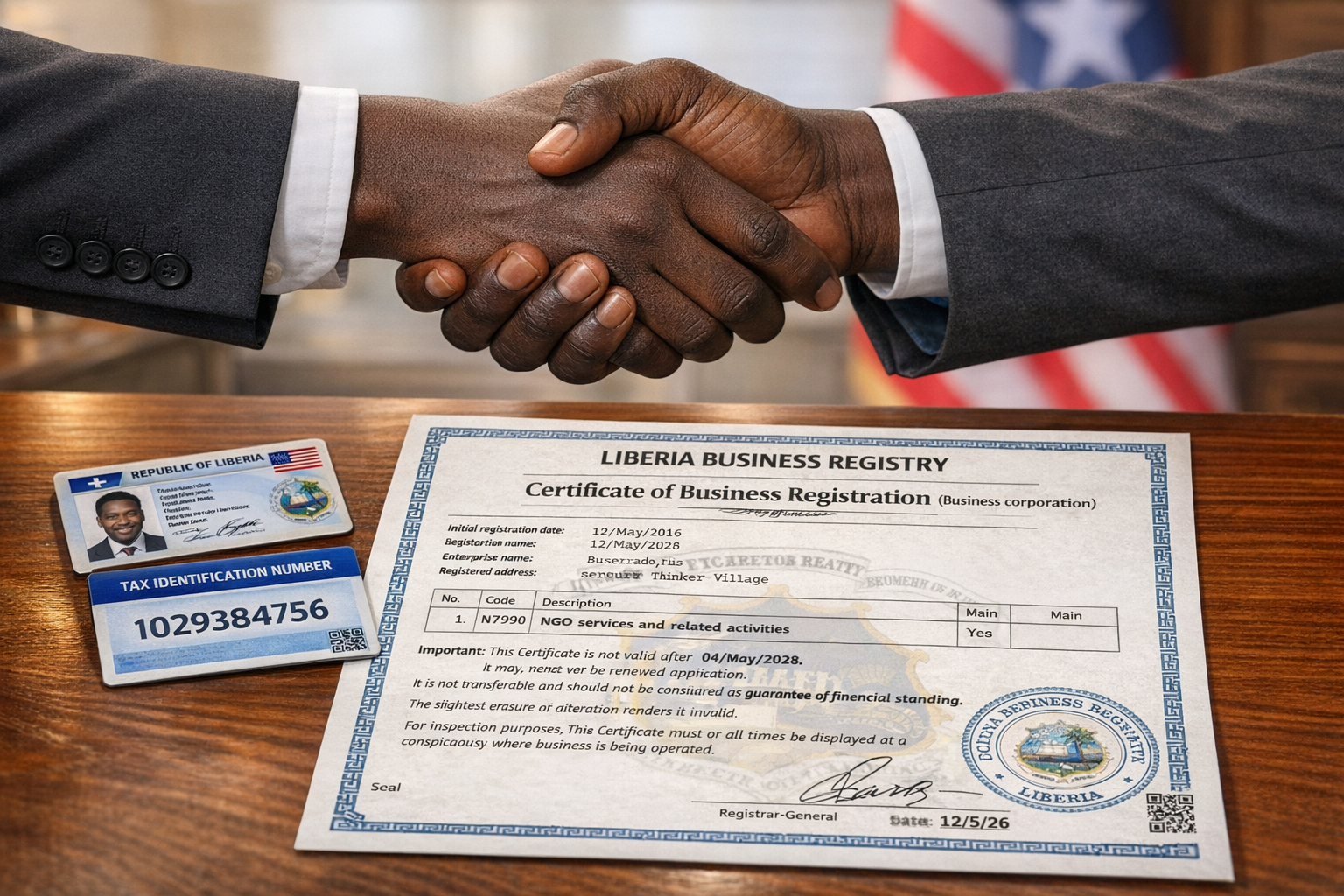
5. Certificate Issuance: After the LRA and MOCI give the final approval, your Business Registration Certificate is printed. This document must be renewed annually to remain valid.
NGO and Non-Profit Registration
Registration for Not-For-Profit entities involves additional steps beyond the LBR. Non-profits must have at least three persons for incorporation and cannot issue shares or distribute profits. NGOs must acquire legal status from the Ministry of Foreign Affairs (for international NGOs) or the National Legislature (for local NGOs), then obtain accreditation from the Ministry of Planning & Economic Affairs.
Fees: Local NGOs approximately pay an accreditation fee of $150 USD, while international NGOs pay $350 USD. All NGOs must provide a mission statement, constitution, evidence of a head office in Liberia, and a list of resident officers.
Taxation in Liberia: Obligations and Rates Taxation is the price of a functioning market. The Revenue Code of Liberia dictates how much of your profit contributes to the public good. It is important for every business owner to know and understand Liberia’s tax obligations because taxation is not just a legal requirement, but a core part of responsible business management.
A clear understanding of the Revenue Code helps an entrepreneur plan properly, keep accurate financial records, price goods and services realistically, and avoid penalties, interest, or disruptions to operations caused by non-compliance. Below is a breakdown of the standard fiscal expectations: Corporate Income Tax: Standard corporations are taxed at a flat rate of 25% on their net taxable income.
Small Business Tax: To encourage micro-enterprises, businesses earning less than L$3,000,000 annually may qualify for a simplified turnover tax of 4%. Goods & Services Tax (GST): This is applied to certain manufactured goods and services, typically ranging from 7% to 12%. Note that as of 2026, Liberia is transitioning toward a Value Added Tax (VAT) system.
Personal Income Tax: Employers must withhold tax from employee salaries based on a progressive scale ranging from 0% to 25%. It is vital to remember that failing to file returns, even if your business made no profit during the period, can result in "Null-filing" penalties.
Employment Regulations: The Decent Work Act
An entrepreneur should evaluate the Decent Work Act at or before registering a business in Liberia because employment obligations begin shaping the business long before the first employee is hired. Wages, working hours, contracts, leave, workplace safety, social protections, and termination procedures all affect startup costs, staffing plans, and operational structure.
If these legal responsibilities are not considered early, a business may register with unrealistic financial projections or a weak employment model that later creates compliance problems, labor disputes, or unexpected costs. Understanding the Act from the start helps the entrepreneur build a business that is legally sound, financially prepared, and capable of managing workers fairly and responsibly. The Decent Work Act of 2015 ensures that the Liberian workforce is treated with dignity.
Minimum Wage: The law mandates a minimum wage of $0.68 USD per hour for most private-sector workers. For agricultural workers, this is adjusted to $0.43 USD per hour.
Social Security (NASSCORP): Employers are required to contribute 4% of an employee's gross salary to the National Social Security and Welfare Corporation.
Leave Entitlements: After one year of service, employees are entitled to a minimum of two weeks of paid annual leave. Maternity leave is set at 12 weeks of paid rest.
Termination: Termination must be based on capacity, conduct, or operational requirements (redundancy), and usually requires a notice period ranging from one to four weeks depending on tenure.
Penalties for Non-Compliance
The "cost of doing business" increases exponentially when laws are ignored. The Liberian government has empowered the LRA and MOCI to enforce strict penalties.
Operating Without a License: Businesses found operating without a valid certificate can be shut down immediately and fined up to $500 USD or more.
Late Renewal: Registration certificates expire every 12 months. Failing to renew within the grace period results in daily administrative fines that accumulate quickly.
Tax Evasion: Under-reporting income or failing to remit withheld employee taxes can lead to seizure of assets, frozen bank accounts, and criminal prosecution.
Labor Violations: Failing to pay minimum wage or ignoring safety standards can lead to expensive lawsuits at the Labor Court, where settlements often favor the employee if documentation is missing.
Common Challenges and How to Mitigate Them
Even with a clear guide, the business registration process in Liberia can present practical challenges. One of the most common problems is incomplete or inconsistent paperwork. Applications are often delayed or rejected because the information provided on registration or TIN forms does not exactly match the applicant’s identification documents.
Business owners should therefore review all names, dates, addresses, and supporting details carefully before submission. Another frequent risk is the “agent” trap. Many individuals positioned around registration offices offer informal assistance for a fee, but relying on unverified intermediaries can expose an investor to forged documents, false promises, and unnecessary costs. It is always safer to work with a licensed attorney, a recognized business consultant, or the appropriate government office directly.
Conclusion
Registering a business in Liberia is more than a legal formality, it is an investment in your brand’s future. By following the outlined steps and adhering to the taxation and employment laws, you move from being an "informal trader" to a "recognized entrepreneur." This transition opens doors to bank loans, government contracts, and international partnerships that are otherwise inaccessible.